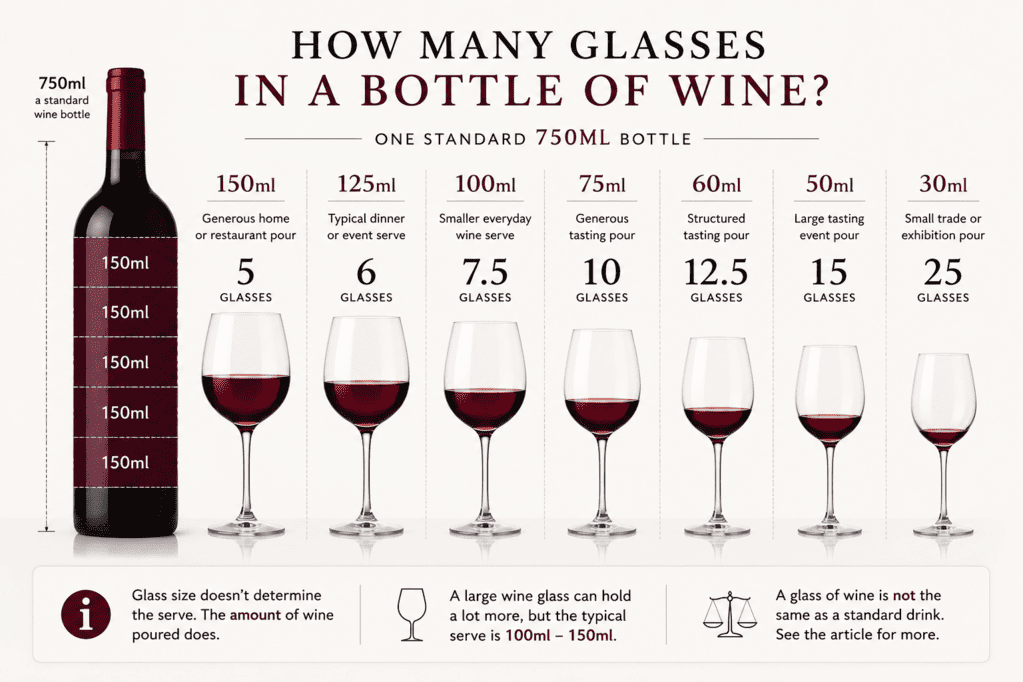
A standard 750ml bottle of wine will give you how many glasses of wine? The quick answer? A standard 750ml bottle of wine will give you around five 150ml glasses, or six 125ml glasses.
Simple enough. Except, of course, it depends on how generously you pour. A bottle shared between two people over dinner is a very different proposition to a bottle being poured at a wedding, a wine tasting or a large event. And anyone who has poured wine at home knows that a “glass” is not exactly a precise unit of measurement.
How many mls in a standard glass of wine?
Very broadly, 100-150ml from a 750ml bottle is a standard glass of wine, however, there is one important thing to clear up from the start: A glass of wine is not necessarily one standard drink.
So whether you’re working out how much wine you need for dinner, catering for a party, planning a tasting, or simply wondering how much is actually going into your glass, here’s how the numbers stack up.
How many glasses are in a standard 750ml bottle of wine?
The maths is straightforward. Take the 750ml in the bottle and divide it by the size of the pour.
| Wine pour | Serves from a 750ml bottle | Common use |
| 150ml | 5 glasses | Generous home or restaurant serve |
| 125ml | 6 glasses | Dinner or event service |
| 100ml | 7.5 glasses | Smaller wine serve |
| 75ml | 10 glasses | Wine tasting |
| 60ml | 12.5 glasses | Structured tasting |
| 50ml | 15 glasses | Larger tasting event |
| 30ml | 25 glasses | Small trade or exhibition tasting |
So while five glasses per bottle is a handy rule of thumb, it is certainly not a universal one.
The size of the glass doesn’t tell you much about the number of glasses in a wine bottle either.
What is the size of a wine glass?
Modern wine glasses can hold 500ml, 600ml or even more. That doesn’t mean they should be filled anywhere near the top. A large glass is there to give the wine some room, allowing you to swirl it and get the aromas working, not to accommodate half a bottle at once.
Well… most of the time.
How many glasses of wine are in a bottle at home?
For most people searching “how many glasses in a bottle of wine?”, this is probably what they really want to know.
If you’re pouring around 150ml per glass, a standard bottle gives you five glasses. Drop the pour back to 125ml and you’ll get six.
That means one bottle shared between:
- Two people: around 2.5 x 150ml glasses each
- Three people: around 1.7 glasses each
- Four people: around 1.25 glasses each
- Five people: one 150ml glass each
Of course, very few home pours involve getting the Pyrex measuring jug out first.
And this is where large wine glasses can be deceptive. A perfectly respectable 150ml pour can look a little stingy sitting in the bottom of a big Burgundy glass, so it is surprisingly easy for a “normal glass” at home to become 175ml, 200ml or more.
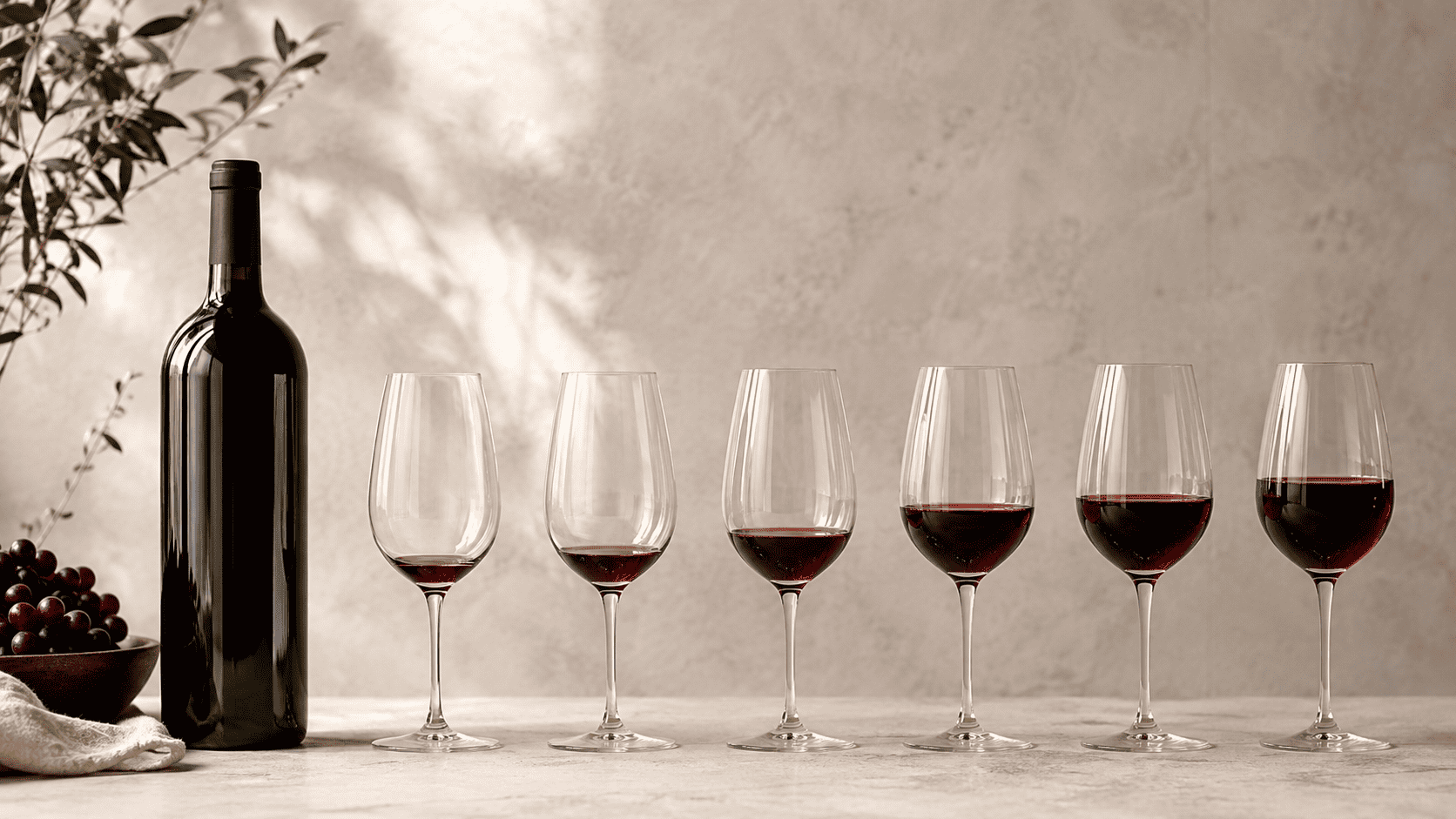
Try measuring 100ml, 125ml and 150ml into your usual wine glass once. You may be surprised at what they actually look like.
How much wine should you pour into a glass?
There isn’t one correct amount. For general wine service, somewhere around 100ml to 150ml is fairly typical.
In fact, smaller pours can often make for a better experience, particularly if you’re opening several wines over lunch or dinner. There’s more room to swirl the wine, you can watch it change in the glass, and you’re not faced with the prospect of drinking a full 150ml of every bottle on the table.
The important point is: The capacity of the glass is not the serving size.
A large Burgundy glass might comfortably hold 700ml, but a 100ml or 125ml pour can still be exactly what you want in it.
How many bottles of wine do I need for a dinner party?
This is where knowing how many glasses of wine are in one bottle suddenly becomes quite useful.
A simple starting point is:
Number of guests × number of serves per guest ÷ number of glasses per bottle = number of bottles
Say you’re having 12 people for dinner and want enough wine available for three 125ml serves per person.
12 guests × 3 serves = 36 glasses
At six 125ml glasses per bottle:
36 ÷ 6 = 6 bottles
That’s the mathematics. In the real world, it is generally sensible to allow for the inevitable generous pour as well.
How many bottles of wine you actually need will also depend heavily on the occasion:
- How long is the lunch or dinner?
- Are you serving Champagne or sparkling wine on arrival?
- Will there also be beer, spirits or non-alcoholic drinks?
- Are you opening several different wines?
- Are many guests driving?
- Are particular wines being matched to different courses?
- How many people are actually drinking wine?
A six-person dinner where everyone is there to enjoy the wine is a completely different proposition to a 20-person barbecue where wine is just one of several things being served.
How many bottles of wine do I need for a wedding or large event?
Once you get into bigger events, “one bottle per person” isn’t a particularly useful way to calculate things.
Not everyone drinks wine. Not everyone drinks at the same rate. And if beer, spirits and other drinks are available, wine might only make up part of what people choose.
It makes more sense to think in terms of serves available.
Using a 125ml pour, you’ll get approximately six serves from each bottle.
| Guests | 2 x 125ml wine serves each | 3 x 125ml wine serves each |
| 20 | 7 bottles | 10 bottles |
| 30 | 10 bottles | 15 bottles |
| 50 | 17 bottles | 25 bottles |
| 75 | 25 bottles | 38 bottles |
| 100 | 34 bottles | 50 bottles |
| 150 | 50 bottles | 75 bottles |
This is really just the starting point. You then need to apply a little common sense based on the event itself.
A seated dinner
Wine is generally easier to manage because bottles are being served at tables, usually alongside food.
A cocktail-style event
Things become less predictable. Guests move around, glasses get put down and forgotten, fresh glasses are picked up, and enthusiastic wait staff have a habit of topping things up whenever they pass.
All of that tends to increase the amount of wine you need.
How many bottles of Champagne do I need for a toast?
This is one occasion where it’s very easy to order too much. If Champagne is being poured purely for a toast, there is usually no need to give everyone a full 125ml glass.
A 75ml pour gives you approximately 10 serves from one 750ml bottle.
So for 100 guests, 10 bottles theoretically gives everyone one 75ml pour.
The word “theoretically” is doing a bit of work there. Pours won’t all be exactly 75ml, a little will be lost to spillage, and there is usually someone who would like their glass topped up. Allowing a few extra bottles is sensible.
If Champagne is your main arrival drink rather than something being poured specifically for a toast, use a more normal 100ml to 125ml serving when doing your calculations.
How many tasting glasses are in a bottle of wine?
A tasting is a completely different exercise. Nobody needs 150ml of every wine when working through six, eight or ten bottles.
Casual tasting at home
For a group of friends, 60ml to 75ml per wine is usually plenty.
At 75ml, one bottle gives you approximately 10 tasting serves.
At 60ml, you’re closer to 12 serves.
Structured wine tasting
For something a little more formal, pours of 50ml to 60ml work well.
At 50ml:
750ml ÷ 50ml = 15 tastes
That means a single bottle can comfortably get around a reasonably large group without everyone receiving such a small amount that they can’t properly taste the wine.
How many mls of wine are in a standard drink?
As mentioned earlier, a glass of wine is not the same as a standard drink. This is probably the most important distinction in the whole article.
In Australia, one standard drink contains 10 grams of pure alcohol. That means the amount of wine that equals one standard drink changes depending on the alcohol level of the wine.
For example:
- 150ml of red wine at 13.5% alcohol = approximately 1.6 standard drinks
- 100ml of red wine at 13.5% = approximately 1 standard drink
- A 750ml bottle of red wine at 13.5% = approximately 8 standard drinks
- 150ml of white wine at 11.5% = approximately 1.4 standard drinks
- A 750ml bottle of white wine at 11.5% = approximately 6.8 standard drinks
- A 750ml bottle of Champagne at 12% = approximately 7.1 standard drinks
So it is perfectly possible for a bottle to contain five glasses of wine but eight standard drinks. They are measuring two different things.
How many standard drinks are in a bottle of wine?
The number of standard drinks in a bottle of wine mostly comes down to the wine’s alcohol by volume, usually shown on the label as ABV or alc/vol. A lighter wine at 11% alcohol contains less pure alcohol than a bigger red at 15%, even though both come in exactly the same 750ml bottle.
As a rough guide:
| Alcohol by volume | Approx. standard drinks in 750ml | |
| 11% | 6.5 | |
| 12% | 7.1 | |
| 13% | 7.7 | |
| 14% | 8.3 | |
| 15% | 8.9 |
Fortunately, you don’t need to stand in the kitchen doing the calculation yourself. The easiest and most accurate answer is already printed on the bottle.
Stock, Store & Serve: Build Your Wine Collection with Wine Ark
Calculated how many bottles of wine you need? Wine Ark makes it easy to both find and store your wine collection. Browse our curated wine Marketplace to select the perfect bottles for your event -whether that’s five glasses for a quiet dinner or 50 bottles for a wedding – then use our managed wine storage service to keep them in flawless condition until you’re ready to pour. From selection to preservation, Wine Ark handles it all.